Concrete leveling
Concrete Leveling and Slab Lifting in London, Ontario
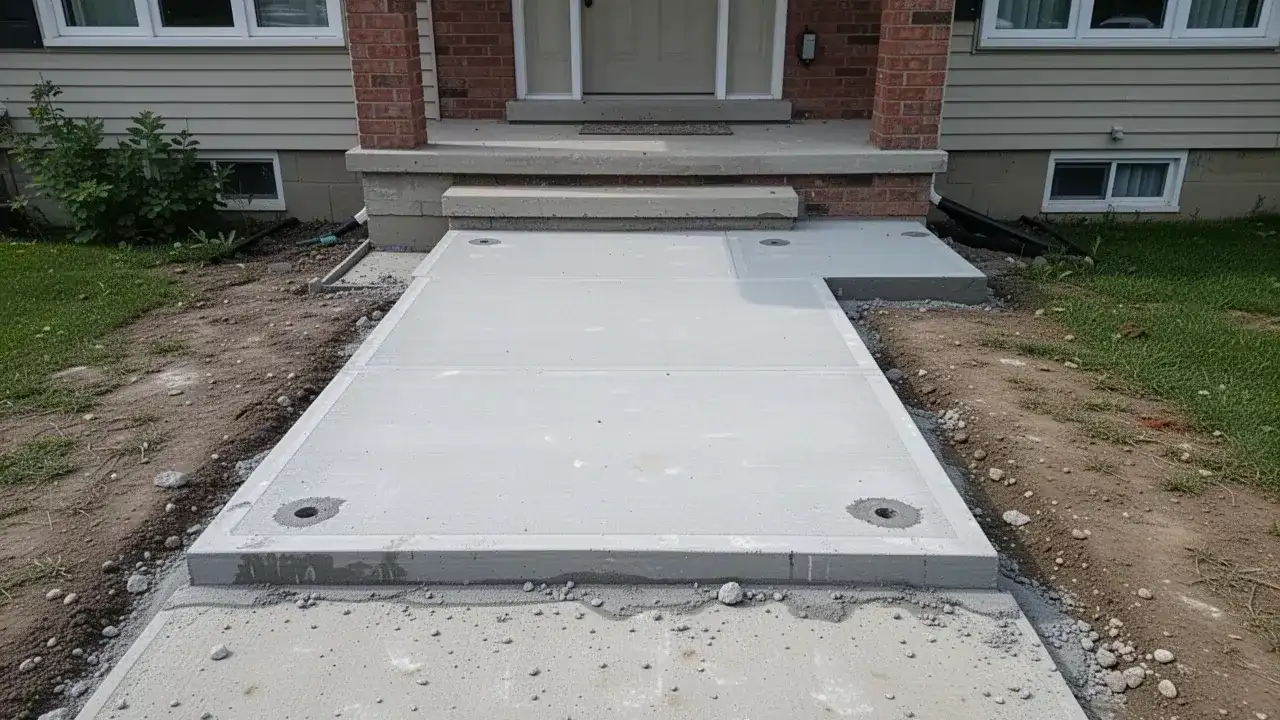
A walkway slab that has dropped two inches, a garage apron tipping toward the door or front steps sinking away from the porch can usually be lifted back into place instead of torn out. Concrete Surface Solutions raises and stabilizes settled concrete for London homeowners, condominium boards and commercial property owners using polyurethane foam injection and traditional mudjacking.
We have spent 20+ years building driveways, walks and steps from the subgrade up, across 950+ jobs, so we know why slabs settle and whether a lift will hold. Our crews are licensed, insured and WSIB-covered, and a typical residential walkway is lifted, patched and sealed in a single morning.
- 20+ years experience
- 950+ jobs completed
- Licensed & insured
- WSIB covered
What we lift
Our Concrete Leveling Services in London
We lift driveways, walkways, steps, porches, patios, pool decks and garage floors that have settled but are still in one piece. On commercial sites we level plaza sidewalks, entrance aprons, loading-dock approaches and interior slabs with hollow spots underneath.
Lifting keeps the concrete you already paid for, avoids a demolition mess and puts the surface back into use the same day. It also removes the lips and gaps that catch toes, snowblower blades and shopping carts.
- Sunken driveway panels and garage aprons
- Front steps and porch slabs
- Walkways and side-entrance paths
- Patios and pool decks
- Garage and basement floors
- Plaza and storefront sidewalks
- Loading-dock approaches
- Warehouse slab voids
Slabs too far gone to lift are a job for our concrete steps, walkways and porches crew or a full concrete driveway installation, and we will tell you which on the first visit.
Root causes
Why Concrete Sinks in London Soils
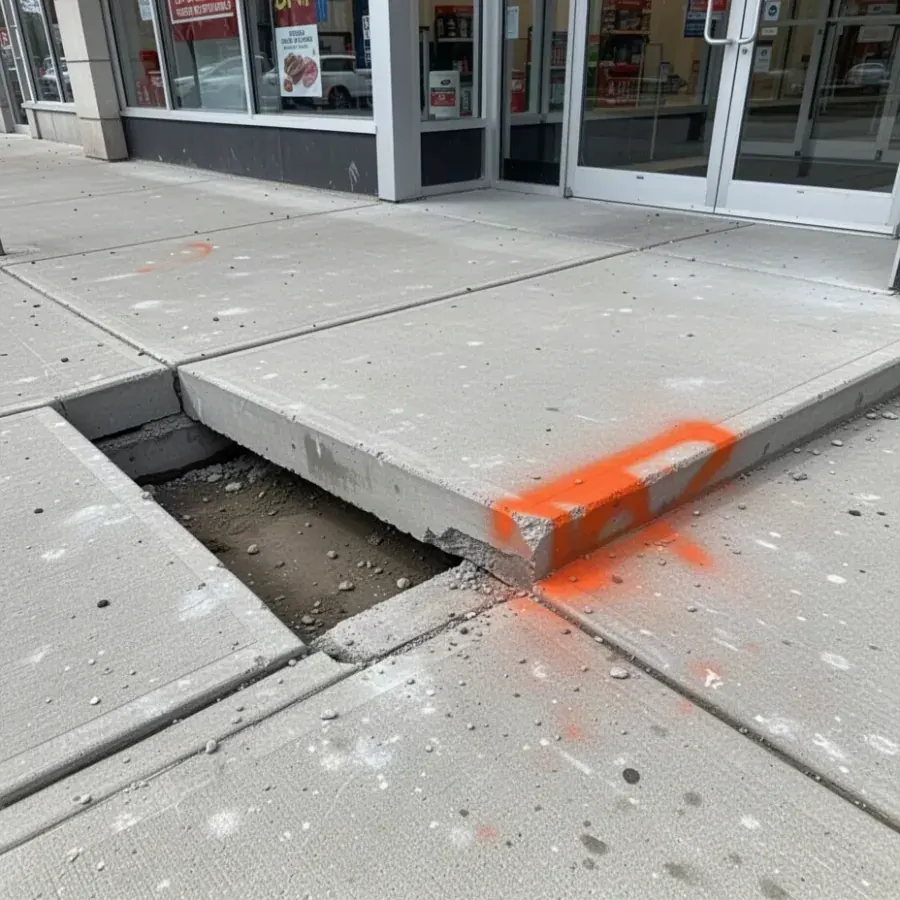
Concrete sinks when the soil underneath it compresses, washes away or was never compacted properly in the first place. London's clay-rich ground makes each of those problems more likely than in sandier parts of the province.
Clay that shrinks and swells
Clay soils swell when saturated and shrink in dry summers. Every cycle leaves slightly less support, and slabs slowly tip toward the weakest spot.
Downspout washouts
A downspout emptying beside a step or walk sends water under the slab in every storm. Fine soil washes out, a void opens up and the concrete cracks or drops into it.
Utility trench settlement
Water, sewer, gas and hydro lines run through trenches that are often backfilled loosely. A driveway poured across one later sinks in a straight line that follows the trench.
Foundation backfill
Soil placed against a new foundation wall keeps settling for several years. Steps, porches and garage aprons resting on it drop toward the house and start steering water at the basement.
Freeze-thaw movement
With frost reaching about 1.2 m (4 ft) deep, water trapped under a slab freezes, pushes it up, then lets it settle unevenly in spring.
Poor original compaction
Slabs placed on loose fill or without a compacted granular base settle in their first few years. We see this most on older patios and do-it-yourself walkways.
Lifting a slab without fixing the water source just resets the clock. We always point out the downspout, gutter or grading problem behind the settlement and suggest the simplest fix.
Options
Lifting Methods Compared
There are three ways to correct settled concrete: lift it with expanding polyurethane foam, float it up with cement slurry, or fill the void beneath it without lifting at all. The right choice depends on the slab, the soil under it and your budget.
On London clay, foam is our default because it adds almost no weight to soft ground. Mudjacking still has a place on large voids over firm soil.
Polyurethane Foam Lifting (Polyjacking)
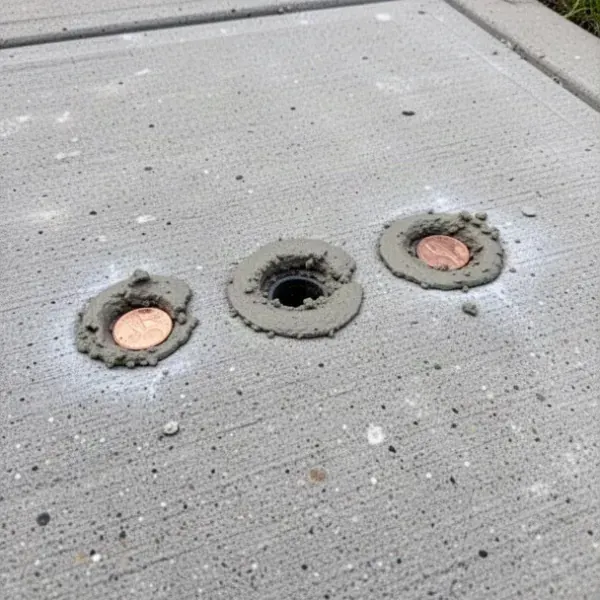
Polyjacking injects a two-part expanding foam through holes about 16 mm (5/8 in.) across. The foam weighs only 2 to 4 lb per cubic foot, so it lifts without loading soft clay, and it reaches most of its strength in about 15 minutes.
We typically specify lifting foams such as those from HMI or Alchatek, which are water-resistant and will not wash out.
Mudjacking and Slab Jacking
Mudjacking pumps a slurry of cement, sand and soil through holes about 25 to 40 mm (1 to 1 5/8 in.) wide to float the slab up. The material costs less than foam, which can make it the better pick for big voids on firm ground.
The trade-off is weight: the slurry is roughly 100 lb per cubic foot, which loads soft clay and can lead to re-settlement. It also needs 24 to 48 hours before vehicles return.
Void Filling and Slab Stabilization
Sometimes a slab is still level but hollow underneath, which you hear as a drum-like sound when it is tapped. We inject low-expansion foam or flowable grout to fill the void without lifting, so the slab stops cracking under load.
This is common under garage floors, behind steps and along foundation walls where backfill has washed away.
| Factor | Polyurethane foam | Mudjacking | Void fill |
|---|---|---|---|
| Hole size | About 16 mm | 25 to 40 mm | About 16 mm |
| Weight added to soil | Very low | High | Low |
| Back in use | About 30 minutes | 24 to 48 hours | About 30 minutes |
| Washout resistance | High | Moderate | High |
| Best for | Most slabs on clay soil | Large voids on firm ground | Hollow but level slabs |
| Relative cost | Moderate | Lower | Lower |
Honest advice
When Leveling Isn't the Right Fix
Leveling only works on a slab that is still largely intact. If the concrete is broken into several pieces, badly scaled or has heaved upward, lifting it just raises a failed slab to a new height.
Lifting makes sense when
- The slab is in one or two solid pieces
- It has dropped rather than heaved
- The surface is in decent shape
- The soil cause can be fixed, such as a downspout or gutter
- Edges and joints are still intact, not crumbling
Repair or replace instead when
- The slab is cracked into three or more loose pieces
- Frost or tree roots have pushed it up (concrete cannot be lowered)
- Scaling or spalling covers much of the surface
- Steps are separating from a failed footing
- The base is saturated with no way to drain it
In those cases, our concrete repair and resurfacing team can saw-cut out the failed panels and patch what is left, or we can quote new concrete on a compacted base.
Our process
How a Slab Lift Is Done
A typical residential foam lift takes 1 to 3 hours on site and follows six steps. Controlled, gradual lifting is what keeps the slab from cracking on the way up.
- Inspect and measure
We measure the drop with a level and string line, sound the slab for hollow areas and trace where the water is coming from.
- Drill injection holes
Holes are drilled through the slab at planned points, spaced to suit its size and where the void sits.
- Inject
Foam is mixed at the gun and injected at low pressure. It fills voids first, then begins to push the slab upward.
- Lift in small increments
We raise the slab a few millimetres at a time, watching a laser or straightedge across the joints so it rises evenly.
- Patch the holes
Each hole is filled flush with a cementitious grout close to the colour of the existing concrete.
- Seal the joints
Joints and the gap against the foundation get flexible polyurethane sealant so water cannot get back under the slab.
Pricing
Concrete Leveling Cost in London
Most residential slab lifts in London cost $500 to $1,500 for most residential lifts, with a $450 minimum for a single small slab. That is usually well under half of what tearing out and repouring the same concrete would cost.
| Problem | Lifting | Replacing |
|---|---|---|
| Sunken walkway panels | $500 to $1,500 for most residential lifts | $12 to $17 per sq ft, plus $2 to $4 per sq ft removal |
| Settled front steps | $500 to $1,500 for most residential lifts | $650 to $1,000 per step |
| Garage apron or driveway panel | $500 to $1,500 for most residential lifts | $12 to $16 per sq ft, plus $2 to $4 per sq ft removal |
| Single trip-hazard slab | $450 minimum | Rarely worth replacing |
Typical 2026 London ranges before HST. Lifting prices include drilling, foam, hole patching and joint sealing.
The biggest variable is how much foam the void swallows, which we estimate on site by sounding the slab. Other factors include:
- Number and size of slabs being lifted
- Total drop to recover
- Access for the hose from the truck
- Crack repair needed at the same time
- After-hours scheduling on commercial sites
- Downspout or drainage corrections
Why us
Why Choose Us for Leveling
We lift slabs with the judgement of a crew that builds them, and every lift is backed by a written 2-year warranty. If we think lifting will not last, we say so before you spend anything.
Controlled equipment and monitoring
Lifting foam is proportioned and heated by a dedicated plural-component rig, then placed through low-pressure guns. Every lift is checked against a laser or straightedge so slabs finish flush with their neighbours.
2-year warranty on the lift
The warranty covers re-settlement of the slabs we lift. Full coverage and exclusions are listed on our concrete warranty page.
We fix the cause, not just the slab
Downspouts, gutter overflows and negative grading get flagged and, where it is simple, corrected during the same visit.
Licensed, insured and WSIB-covered
A certificate of insurance is available on request. Ask for our WSIB clearance certificate and check it on the WSIB clearances page.
Service area
Concrete Leveling Across London and Nearby Towns
We lift sunken concrete throughout London, from newer neighbourhoods like Sunningdale and Summerside, where foundation backfill is still settling, to Old South and Wortley Village, where walks have had decades to sink. In Komoka and Kilworth, many homes are recent builds, and settling backfill under steps and garage aprons is the most common call. Older properties in St. Thomas tend to have long front walks that have dropped panel by panel over the years.
See the full range of residential concrete services for homes, or our commercial concrete work for plazas, offices and industrial sites.
FAQ
Concrete Leveling FAQs
Quick answers to what people ask most before booking a slab lift. Every lift starts with a free on-site measurement.
How long does foam concrete leveling last?
A foam lift lasts as long as the soil under it stays stable, which for most London slabs means many years. Polyurethane lifting foam is inert, does not absorb water and does not break down underground.
When a lifted slab drops again, the cause is almost always a new washout or more clay movement. That is why we deal with the downspout or grading problem and seal the joints during the same visit.
Can I drive on a lifted driveway the same day?
Yes. After a polyurethane foam lift you can usually drive on the slab within about 30 minutes, once the foam has cured and the holes are patched.
Mudjacked slabs are different: the cement slurry needs roughly 24 to 48 hours to firm up before a vehicle goes back on it.
Can you fix a sidewalk trip hazard in front of my business?
Yes, when the sidewalk is on your property. We lift plaza walks, entrance slabs and apron joints, often early in the morning or after closing so your entrance stays open, and most lifts are walkable again within the hour.
If the sunken slab is the public sidewalk, it sits in the City of London road allowance and belongs to the City. Report it to the City first; any private work there needs a Work Approval Permit. For full replacement of private walks and curbs, see our commercial sidewalks, curbs and parking areas service.
Free estimate
Get a Leveling Quote
Send us the location, a photo of the sunken slab and roughly how far it has dropped. We reply within one business day and can usually measure and quote on the same visit.
You will get a written price per slab, the method we recommend and why, and the slab is back in use the same day it is lifted.
- Call or text (226) 243-3585
- Email info@concretesurfacesolutions.ca (attach photos or drawings here)
- Monday to Saturday: 7:00am - 9:00pm
Sunday: 9:00am - 6:00pm
Directions, office hours and what happens after you reach out are on our free concrete estimate page.
Call (226) 243-3585