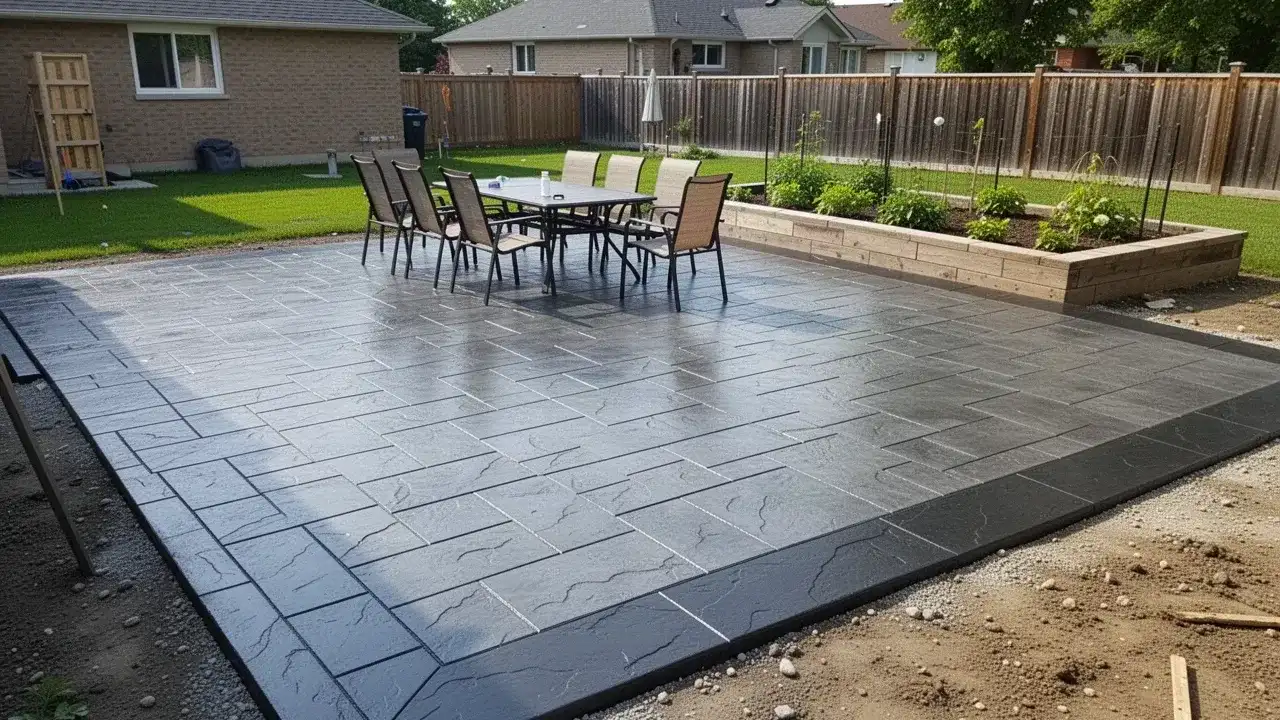
Decorative concrete
Stamped Concrete in London, Ontario
Stamped concrete gives you the look of slate, cut stone, brick or weathered wood in a single poured surface with no joints for weeds to grow through. Concrete Surface Solutions designs and pours stamped patios, walkways, pool decks and driveway borders for homeowners across London and the surrounding counties.
Decorative work is where finishing skill shows. With 20+ years on the tools and 950+ completed jobs, our finishers know how the stamping window shifts between a cool May morning and a humid July afternoon, and that timing decides how crisp the pattern turns out.
We help you pick a pattern and colour combination that suits your house, then explain honestly what it will take to keep it looking good.
- 20+ years experience
- 950+ jobs completed
- Licensed & insured
- WSIB covered
What we pour
Stamped Concrete Patios, Driveways and Walkways in London
Stamped concrete is regular exterior concrete that is coloured and then pressed with flexible polyurethane mats while it is still plastic, leaving the texture and joint lines of natural materials. Once it is sealed, it reads as stone or brick from a few steps away.
It suits homeowners who want a custom, high-end surface and are comfortable resealing it every year or two. Most of our stamped work goes into these four places.
Backyard patios
Our most common stamped job, often paired with a fire table or pergola. See our concrete patio and pool deck service for layout and drainage planning.
Walkways and steps
Front walks that tie the driveway to the porch, with stamped treads and smooth risers.
Pool surrounds
Wood plank and fieldstone textures that grip wet feet at a lower cost than natural stone.
Driveways and borders
Full stamped drives or, more often, a stamped band framing a broom-finish centre.
Honest fit
Where Stamped Concrete Works Best, and Where It Doesn't
Stamped concrete works best on patios, walkways and pool decks, where traffic is mostly feet and nobody plows it. It is a harder choice for a full driveway, because snow-blower blades, studded or chained tires and salty slush wear through the sealer and dull the colour faster.
That does not rule it out, but it changes the maintenance plan. The main drawbacks people search for come down to three things: it needs resealing, a sealed surface can be slippery without grit, and repairs are hard to colour-match.
Great fit
- Backyard patios and outdoor dining areas
- Front walkways and landings with modest foot traffic
- Pool decks using a textured, grit-sealed pattern
- Driveway borders and aprons framing a plain field
- Owners happy to reseal every 1 to 2 years
Think twice
- Full driveways cleared by a plow contractor
- Steep slopes where a smooth pattern gets slick
- Owners who want a surface they never maintain
- Areas under trees that drop staining sap and berries
- Tight budgets where a broom-finish concrete driveway makes more sense
If grip and low upkeep matter more than pattern, compare our exposed aggregate concrete, which hides wear better and needs less frequent resealing.
Design options
Patterns, Colours and Borders
Choosing a stamped design comes down to three decisions: the pattern family, a base colour, and a release colour that settles into the low spots to create depth. A border in a contrasting pattern or colour then frames the whole area.
We bring physical colour charts and pattern photos to the consult, because screen colours rarely match how concrete looks in daylight.
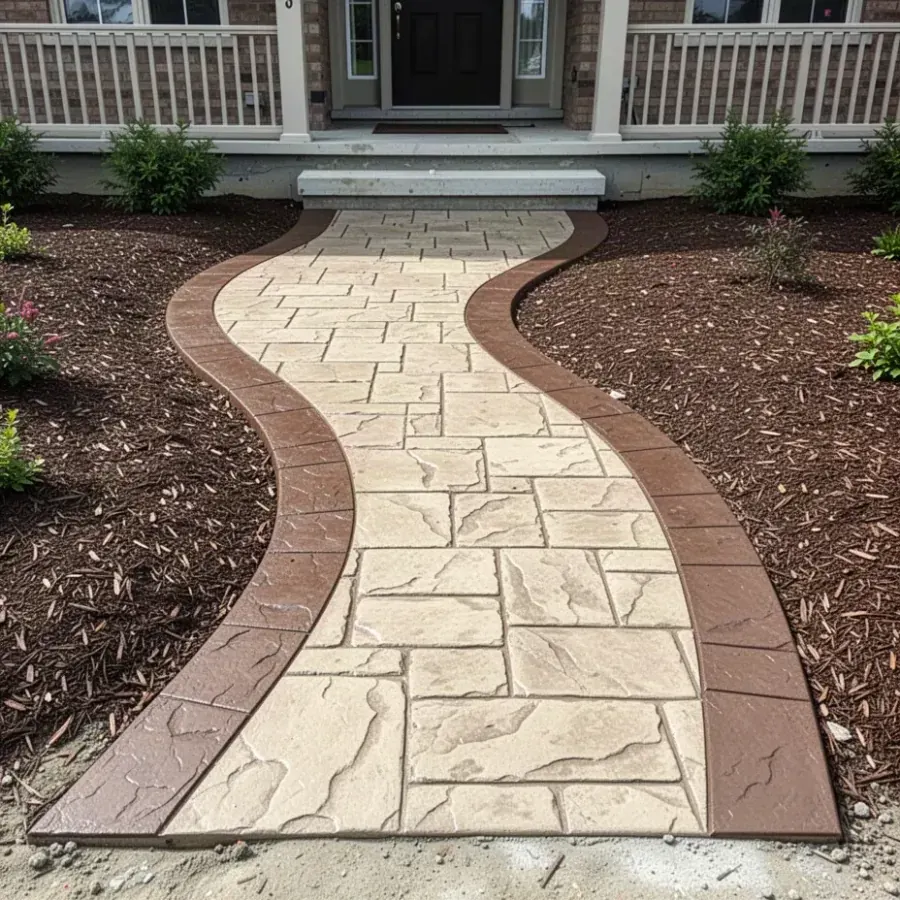
Stone, Slate and Ashlar Patterns
Ashlar slate, random stone and fieldstone are the most requested patterns for patios because they hide hairline cracks and joint lines inside the design. Ashlar uses rectangular cut-stone shapes in mixed sizes, while fieldstone is irregular and more rustic.
A charcoal or sandstone base with a darker release looks natural beside most brick and siding colours.
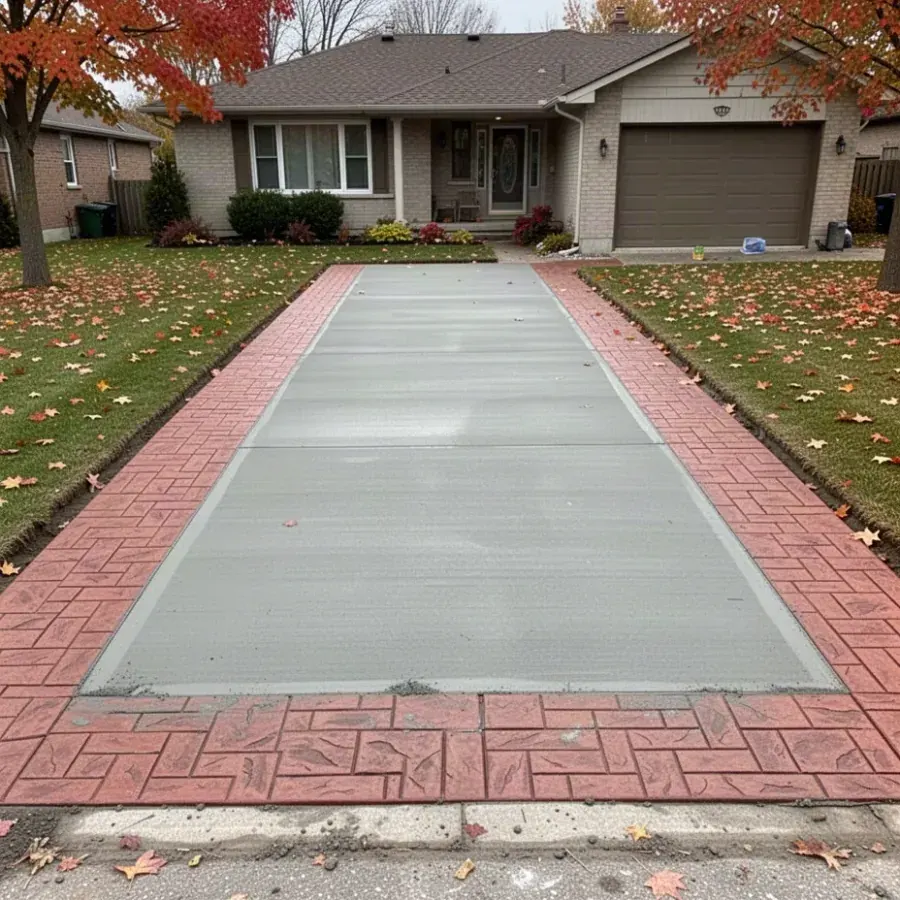
Brick and Cobblestone Patterns
Running bond, herringbone and cobblestone patterns suit older London homes in neighbourhoods like Old South, Wortley Village and Old North, where older brick homes line the streets. They work especially well as a soldier-course border along a driveway or walkway.
Brick patterns need a crisp, well-timed stamp, because soft edges give the look away immediately.
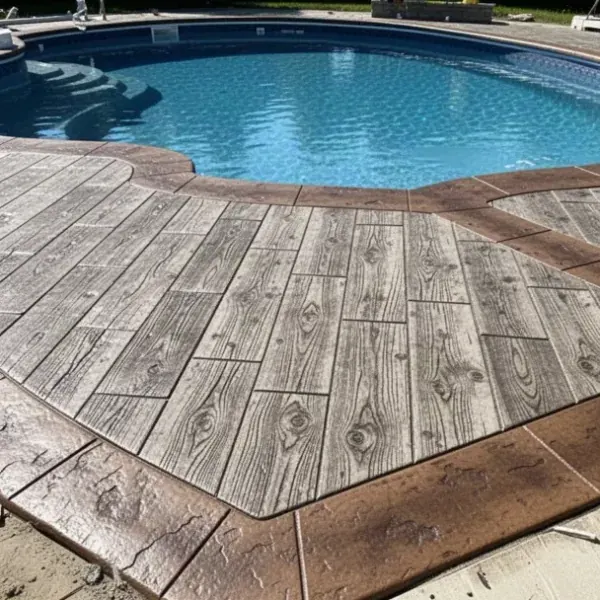
Wood Plank Textures
Wood plank stamps copy board grain, knots and end cuts, giving the warmth of a deck without rot, splinters or annual staining. They are our first suggestion for pool decks and covered patios.
The deep grain texture gives bare feet better grip than a smooth slate pattern.
Colour Hardeners, Release Agents and Accent Borders
For base colour we typically specify a dry-shake colour hardener from systems such as Butterfield Color or Brickform. It is broadcast onto the fresh slab and floated in, giving a denser, more wear-resistant top layer than integral colour alone.
A powdered antiquing release agent stops the mats from sticking and leaves darker highlights in the grout lines. Two-tone designs, such as a charcoal border around a sandstone field, add $2 to $5 per sq ft extra over a single colour.
Comparison
Stamped Concrete vs Interlocking Pavers
Stamped concrete usually costs less to install and never grows weeds between units, while interlocking pavers are easier to repair one piece at a time and do not need sealing. In London's clay soils, frost movement is the deciding factor for many people: pavers can shift individually, while a stamped slab moves as one piece and relies on its base and joints.
| Factor | Stamped concrete | Interlocking pavers |
|---|---|---|
| Installed cost | $18 to $26 per sq ft on driveways | Usually higher for comparable area and pattern |
| Routine upkeep | Clean and reseal every 1 to 2 years | Top up joint sand, pull weeds, reset low pavers |
| Weed and ant growth | None in the field; only at saw-cut joints | Common in sand or polymeric joints over time |
| Frost heave | Slab moves as a unit; controlled by base and joints | Individual pavers can heave or sink unevenly |
| Repairability | Cracks can be patched but are hard to colour-match | Lift and replace single pavers easily |
| Snow clearing | Smooth for shovels; plows wear the sealer | Plow blades can catch raised paver edges |
| Design range | Stone, slate, brick, cobble, wood; any colour pairing | Many shapes and blends; true unit edges |
Paver pricing varies widely by product line, so get a written quote from an interlock installer for an exact comparison.
Our process
How We Pour, Stamp and Seal
A stamped patio of 300 to 500 sq ft is typically 3 to 4 days on site, including forming, the pour and the return visit to wash and seal. The pour day itself is the most demanding, because colour, release and stamping all happen inside a few hours.
Structurally, the slab gets the same air-entrained mix and compacted base we use on our concrete driveway installations.
- Base and forms
We excavate, compact Granular A, and set forms with a gentle fall away from the house so water never ponds on the pattern.
- Pour and colour
The concrete is placed and floated, then colour hardener is broadcast in two passes and worked into the surface paste.
- Release agent
Powdered or liquid release goes down just ahead of the mats, so the texture lifts cleanly and the accent colour settles into the grooves.
- Stamping at the right moment
Mats go down when the surface takes a thumbprint without sticking, often a one to two hour window. Edges and corners are detailed with hand tools.
- Wash and joint cutting
Control joints are cut along pattern lines so they disappear, then the excess release is washed off once the slab has hardened.
- Anti-slip sealer
After curing, two thin coats of a decorative acrylic sealer go on, with fine anti-slip grit added to the final coat.
Pricing
Stamped Concrete Cost in London
Stamped concrete driveways in London typically run $18 to $26 per sq ft, and stamped patios and walks fall in a similar band depending on pattern and access. A plain broom-finish patio, by comparison, is about $11 to $15 per sq ft. The premium pays for colour materials, stamping mats and the extra finishers needed on pour day.
These items move a stamped quote up or down the range:
- Pattern complexity: large ashlar slate is quicker than detailed herringbone brick or wood plank with end joints.
- Number of colours: each extra base or release colour, and each contrasting border, adds $2 to $5 per sq ft extra.
- Steps and landings: stamped treads and formed risers are priced per step, at about $650 to $1,000 per step.
- Access: a backyard pour that needs a pump adds $450 to $900 per pour when a pump is needed.
- Removal: breaking out an old patio or walkway adds $2 to $4 per sq ft.
Budget for upkeep, too
Professional resealing of stamped surfaces costs about $1.75 to $3.00 per sq ft. Over ten years that is a real line item, so we include it in every stamped quote rather than leaving it as a surprise.
Maintenance
Keeping Stamped Concrete Looking New
Stamped concrete stays looking new when it is resealed every 1 to 2 years, cleaned gently each spring, and kept away from harsh de-icers. The sealer is the wear layer: once water stops beading on the surface, it is time for a fresh coat.
Reseal on schedule
Patios usually go 2 years between coats; driveways and front walks often need one every year. Our concrete sealing service strips, cleans and recoats with grit included.
Go easy on de-icers
No de-icers the first winter. After that, use rock salt sparingly, avoid ammonium-based products, and use a plastic shovel or a blade with a rubber edge.
Clean gently
A garden hose, a soft brush and a pH-neutral cleaner handle most dirt. Keep pressure washers moving and at a low setting so they do not strip the sealer.
If an older stamped surface has turned white and cloudy, the sealer has trapped moisture, a problem called blushing. It can usually be corrected without stripping, and deeper cracks or flaking go to our concrete repair team.
Why us
Why Choose Us for Decorative Work
Decorative concrete is unforgiving: a mistimed stamp or patchy colour is permanent. Homeowners pick us because our finishers do this work regularly and because we put the materials, sealer and warranty in writing.
Experienced decorative finishers
20+ years of flatwork means our crew reads set time by feel, adjusts for sun and wind, and staffs pour day so no section is stamped late.
A design consult before the quote
We walk the area with you, sketch the layout and border lines, and match colours to your brick or siding in daylight.
Warranty on the work and the sealer
New stamped installations carry our 3-year workmanship warranty, and our sealer application carries a 1-year warranty. Coverage and exclusions are spelled out on our written warranty page.
Finished work you can inspect
See stamped patios, walks and borders in our project gallery, and ask for our WSIB clearance and certificate of insurance before any work starts.
Stamped work is one part of our residential concrete services, so the same crew can pour your driveway, steps and patio as one coordinated project.
Service area
Stamped Concrete Across London and Surrounding Towns
We pour stamped concrete throughout London and the towns around it. In Komoka and Kilworth, the newer subdivisions west of the city have plenty of open backyards waiting for a first patio, which is where stamped slate and wood plank designs get the most use.
In St. Thomas, the older brick homes near the downtown core pair naturally with brick and cobblestone patterns on front walks and porches.
FAQ
Stamped Concrete FAQs
These answers cover the questions we hear most during stamped concrete consults. Call (226) 243-3585 if you want to talk through a specific design.
Is stamped concrete slippery when wet?
It can be if it is sealed with a glossy coat and nothing else, especially on smooth slate patterns. We mix a fine anti-slip grit into the final sealer coat on every stamped job, which gives wet surfaces noticeably more grip without feeling rough underfoot.
Around pools and on steps we also steer clients toward deeper textures such as wood plank or fieldstone, which drain and grip better than flat tile patterns.
How long does stamped concrete last in Ontario?
The slab itself lasts 25 years or more when it is poured with an air-entrained exterior mix on a proper base. What wears is the sealer and, over decades, the coloured surface layer.
Resealing every 1 to 2 years is what keeps the colour deep and the surface protected. Stamped concrete that is never resealed can look tired within five or six winters even though it is structurally fine.
Can stamped concrete handle road salt?
Yes, provided it is air-entrained, fully cured and sealed. Skip all de-icers through the first winter, then use plain rock salt sparingly and never products containing ammonium nitrate or ammonium sulphate.
On driveways, salty slush from vehicles is harder on the sealer than the salt you spread, so a spring rinse and a check of the sealer each year pay off. Our concrete sealing service can handle the recoat for you.
Free design consult
Book a Stamped Concrete Design Consult
Tell us where the stamped concrete is going and roughly how big it is. We will reply within one business day to book a visit with pattern photos and colour charts in hand.
Your quote will list the pattern, colour system, sealer and resealing cost, so there are no surprises later.
- Call or text (226) 243-3585
- Email info@concretesurfacesolutions.ca (attach photos or drawings here)
- Monday to Saturday: 7:00am - 9:00pm
Sunday: 9:00am - 6:00pm
Directions, office hours and what happens after you reach out are on our free concrete estimate page.
Call (226) 243-3585