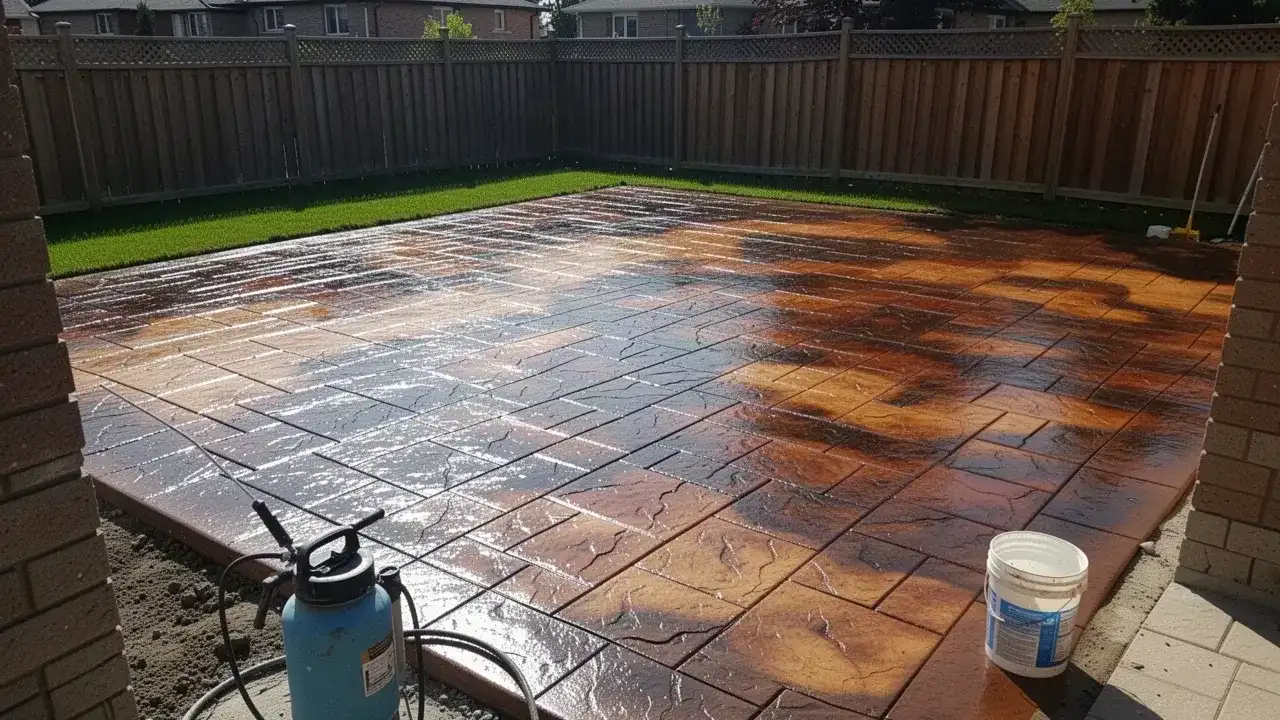
Concrete cleaning and sealing
Concrete Sealing in London, Ontario
Unsealed concrete soaks up salty slush all winter, and that brine is what turns a smooth driveway into a flaking one within a few seasons. Concrete Surface Solutions cleans and seals driveways, patios, walkways, pool decks and stamped concrete for London homeowners, condominium corporations and commercial properties.
With 20+ years of pouring and finishing concrete in this region and 950+ jobs behind us, we pick sealers by surface and exposure, not by whatever happens to be on the store shelf. Our licensed, insured, WSIB-covered crew handles everything from pressure washing to the final anti-slip coat.
- 20+ years experience
- 950+ jobs completed
- Licensed & insured
- WSIB covered
What we seal
Concrete Sealing Services for Driveways, Patios and Floors
We clean, seal and reseal concrete of every finish: broom-finish driveways, stamped and coloured patios, exposed aggregate walks, pool decks, steps and garage or shop floors. Every job starts with a deep clean, because sealer locks in whatever is on the surface.
For plain concrete the goal is invisible salt protection. For decorative concrete it is protection plus colour, so the sealer, number of coats and anti-slip treatment change from one surface to the next.
Driveways and walkways
Penetrating sealers for broom-finish surfaces, including new slabs from our concrete driveway installation crew once they have fully cured.
Stamped and exposed aggregate
Gloss or satin resealing that brings back colour on stamped concrete and keeps stones locked in on exposed aggregate concrete.
Maintenance resealing
Scheduled cleaning and resealing every 1 to 2 years for homes, condo walkways and storefronts, with a reminder before each season.
The problem
How Salt and Water Damage Unsealed Concrete
Water carrying dissolved salt soaks into the tiny capillary pores of unsealed concrete, and when it freezes it expands by about 9%, popping off the surface layer. That flaking is called scaling, and London driveways go through freeze-thaw cycles again and again every winter.
Salt makes it worse in two ways. It keeps the surface wetter for longer, so more water is in the pores when the temperature drops, and calcium and magnesium chloride brines can react chemically with the cement paste.
Given enough years, chlorides also reach the reinforcing steel and start it rusting. Rust expands and breaks off chunks of concrete, which is spalling.
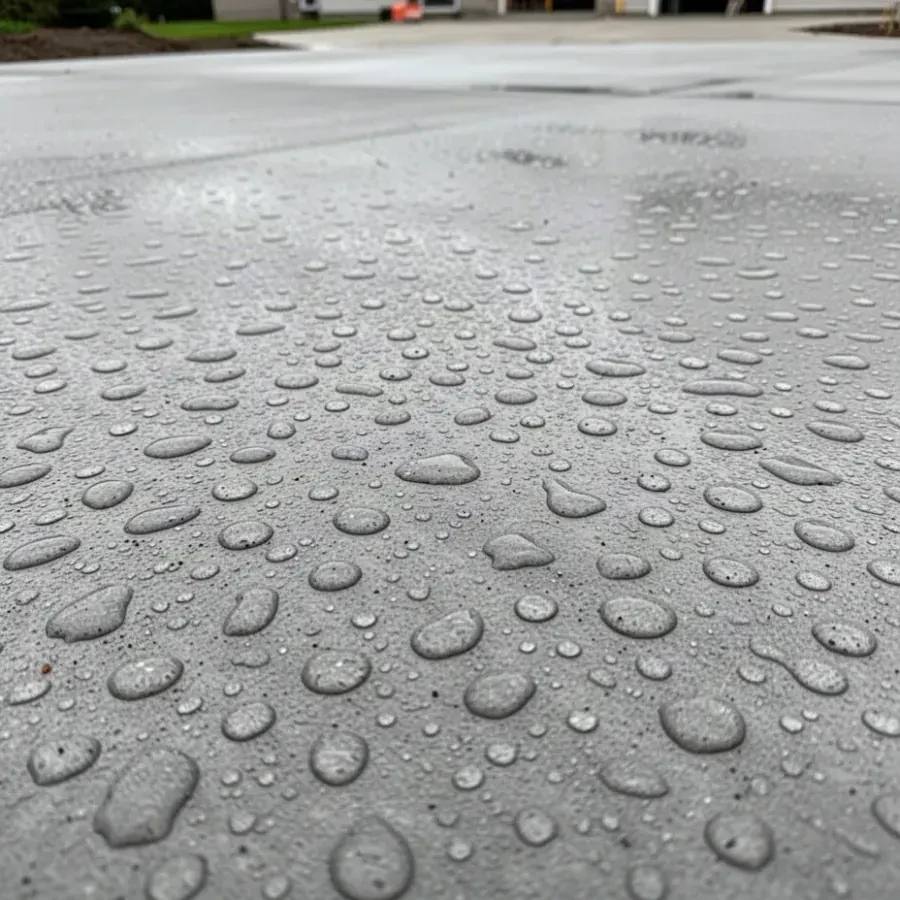
A good sealer cuts water and chloride absorption sharply, which is why the drops in the photo bead up instead of soaking in. Concrete Ontario's Residential Flatwork Guide recommends sealing exterior concrete and keeping de-icers off it in the first winter.
The de-icer you choose matters as much as the sealer. Products containing ammonium nitrate or ammonium sulfate, including lawn fertilizer used to melt ice, attack the cement paste directly and can scale even sealed concrete. Plain rock salt used sparingly, or sand for traction, is far kinder to a driveway.
Sealing slows scaling but cannot reverse it. If your concrete is already flaking or cracked, our concrete repair and resurfacing service fixes the damage first, and the sealer goes on afterward.
Products
Sealer Types We Use
We use three kinds of product, each for a different job: penetrating sealers for salt protection, film-forming acrylics for decorative concrete, and anti-slip additives wherever a glossy surface gets wet. Most plain driveways need only the first; most stamped patios need the second and third together.
Choosing the right concrete sealer matters more than the brand on the pail, and all of them go on in thin, even coats. Over-applying any sealer wastes product and causes most of the cloudy, peeling finishes we are asked to strip.
Penetrating Silane and Siloxane Sealers
Silane and siloxane sealers soak a few millimetres into the concrete and react to line the pores with a water-repellent layer, leaving no film on top. They do not change the look or traction, let vapour escape, and give the best chloride protection for driveways, walks and garage aprons.
We typically specify products such as Sikagard-219, a penetrating concrete protector sold in Canada.
Acrylic Cure-and-Seal and Gloss Sealers
Acrylic sealers form a thin film that deepens colour and gives stamped and coloured concrete its wet look. We typically use solvent-based products such as Euclid Super Diamond Clear TB, a cure-and-seal sold only in Canada that works on fresh concrete as a curing compound and on older slabs as a maintenance coat.
Film sealers wear in tire paths and need recoating more often than penetrating types.
Anti-Slip Additives
Any gloss sealer turns slick when wet, so we blend a fine anti-slip grit into the final coat. We treat it as mandatory on stamped concrete, pool decks, steps and sloped walks.
The grit adds grip you can feel underfoot while staying almost invisible, and it does not dull the colour.
| Factor | Penetrating silane or siloxane | Acrylic cure-and-seal |
|---|---|---|
| Appearance | Invisible, natural finish | Wet look, deeper colour, satin to gloss |
| Salt protection | Excellent | Good while the film is intact |
| Traction | Unchanged | Needs anti-slip grit |
| Best surfaces | Broom-finish driveways, walks, garage aprons | Stamped, coloured and exposed aggregate |
| Wear pattern | Fades gradually from within | Wears first in tire paths and doorways |
| Reseal interval | About every 2 years | About every 1 to 2 years |
On mixed properties we often use both: a penetrating sealer on the plain driveway and a gloss acrylic on the stamped walkway and porch. That way each surface gets the protection and look that suits it, and you are not paying for gloss where nobody will see it.
Our process
Our Cleaning and Sealing Process
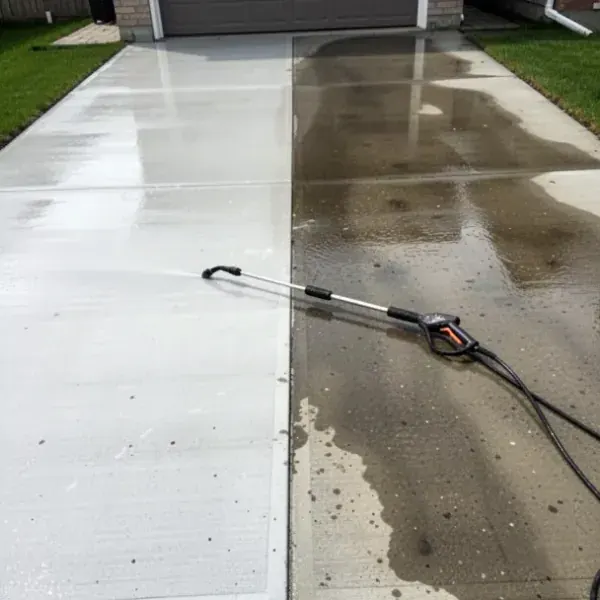
A sealer is only as good as the surface it goes on, so more than half of every job is cleaning and drying. The photo shows a driveway after washing, ready to dry out before the first coat.
Most residential driveways take one visit for washing and a second, a day or two later, for sealing.
- Inspect and test
We sprinkle water to see whether the old sealer still repels it, and identify what type it is, since some products cannot go over others.
- Pressure wash
A rotary surface cleaner at around 3,000 psi lifts dirt, salt residue, moss and loose old sealer. Oil spots get a degreaser and white efflorescence gets a masonry cleaner.
- Repair
Cracks are routed and sealed and small spalls patched first, so the sealer protects sound concrete instead of hiding defects.
- Let it dry
Concrete needs at least 24 hours to dry after washing, longer in shade or humid weather. Sealing damp concrete is the main cause of white, cloudy acrylic.
- Apply
We spray and back-roll two thin coats within the maker's temperature window, generally 10 to 30°C, with no rain forecast for 24 hours.
- Cure
Foot traffic can usually return in 4 to 8 hours and vehicles in 24 to 48 hours. We tape off the area and leave written care instructions.
Pricing and upkeep
Sealing Cost and Maintenance Schedule
Driveway sealing in London typically costs $1.25 to $2.50 per sq ft for plain broom-finish concrete, and stamped, coloured or exposed aggregate concrete runs $1.75 to $3.00 per sq ft because it needs more cleaning, two coats and an anti-slip additive. Plan to reseal every 1 to 2 years, as Concrete Ontario recommends.
| Surface | Price per sq ft | Typical total |
|---|---|---|
| Broom-finish two-car driveway (about 600 sq ft) | $1.25 to $2.50 per sq ft | $750 to $1,500 |
| Front walkway and steps (about 150 sq ft) | $1.25 to $2.50 per sq ft | $190 to $380 |
| Stamped patio (about 400 sq ft) | $1.75 to $3.00 per sq ft | $700 to $1,200 |
| Exposed aggregate driveway (about 600 sq ft) | $1.75 to $3.00 per sq ft | $1,050 to $1,800 |
Typical 2026 London prices before HST, including cleaning and sealer. Heavy stripping of failed old sealer is quoted separately.
Keeping to a schedule costs far less than repairing scaled concrete later. This is the routine we recommend for London concrete:
| When | What to do |
|---|---|
| Day of the pour | Cure-and-seal on decorative work, or a curing compound on plain concrete |
| After 28 days | First penetrating sealer on broom-finish slabs |
| First winter | No de-icers at all; shovel promptly and use sand for traction |
| Every spring | Rinse off salt residue and do the water-bead test |
| Late summer to early fall | Best window to reseal before salt season, while days stay above 10°C |
| Every 1 to 2 years | Full clean and reseal; gloss finishes and busy driveways at the shorter interval |
Why us
Why Choose Us for Sealing
We name the products we use, write the sealer and coverage rate on your invoice, and back the work with a written 1-year warranty. You know exactly what went on your concrete and when it is due again.
Named, professional-grade products
Contractor-grade penetrating and solvent-based acrylic sealers, not big-box water-based products that wear off in one winter.
1-year sealing warranty
Coverage and exclusions are set out in writing on our concrete warranty page.
Concrete people, not just sealer people
We spot the cracks, scaling and drainage problems a wash-and-seal outfit would roll right over, and fix them before sealing.
Licensed, insured and WSIB-covered
A certificate of insurance is available on request. Ask for our WSIB clearance certificate and verify it on the WSIB clearance site.
Service area
Concrete Sealing Across London and Nearby Towns
We seal driveways, patios and walkways across London, from Masonville and Hyde Park to White Oaks and Westminster. In Strathroy, many homeowners commute on Highway 402 and salted county roads, so brine rides home on their tires all winter and collects in the tire paths. Woodstock sits where Highways 401 and 403 meet, and driveways there carry the same heavy salt load, so a fall seal pays for itself quickly.
For new concrete, browse our residential concrete services; every decorative surface we pour leaves with its first coat of sealer and a reseal date.
FAQ
Concrete Sealing FAQs
Answers to the sealing questions we hear most from London homeowners. Ask us anything else when you request your quote.
How often should concrete be sealed in Ontario?
Every 1 to 2 years for most exterior concrete, which is the interval Concrete Ontario recommends. Driveways with heavy salt and traffic, and glossy acrylic finishes, usually need the 1-year end; penetrating sealers on lightly used walks can often stretch to 2.
A simple test tells you when: sprinkle water on the surface. If it soaks in and darkens the concrete instead of beading, the protection has worn off.
How soon can new concrete be sealed?
A penetrating sealer goes on after the concrete has cured for about 28 days, so the slab has dried enough to absorb it. Acrylic cure-and-seal products are the exception, since they are made to be sprayed on fresh concrete right after finishing to hold in curing moisture.
Either way, keep de-icing salt off new concrete for its whole first winter, as Concrete Ontario advises.
Will sealer make my driveway slippery?
A penetrating sealer will not, because it leaves no film on the surface. Gloss acrylic sealers can be slick when wet, so we add an anti-slip grit to the final coat on stamped concrete, steps, pool decks and sloped driveways.
If grip is your top priority, we can use a penetrating sealer on the driving lanes and a gloss finish only on decorative borders.
Free estimate
Book Your Concrete Sealing
Our sealing season runs roughly May through October, while days stay above 10°C and concrete can dry between rains. Spring dates go to driveways that took a beating over winter, and fall dates fill quickly before salt season, so book early.
Send the surface type and rough size and we will reply within one business day with a price and available dates.
- Call or text (226) 243-3585
- Email info@concretesurfacesolutions.ca (attach photos or drawings here)
- Monday to Saturday: 7:00am - 9:00pm
Sunday: 9:00am - 6:00pm
Directions, office hours and what happens after you reach out are on our free concrete estimate page.
Call (226) 243-3585