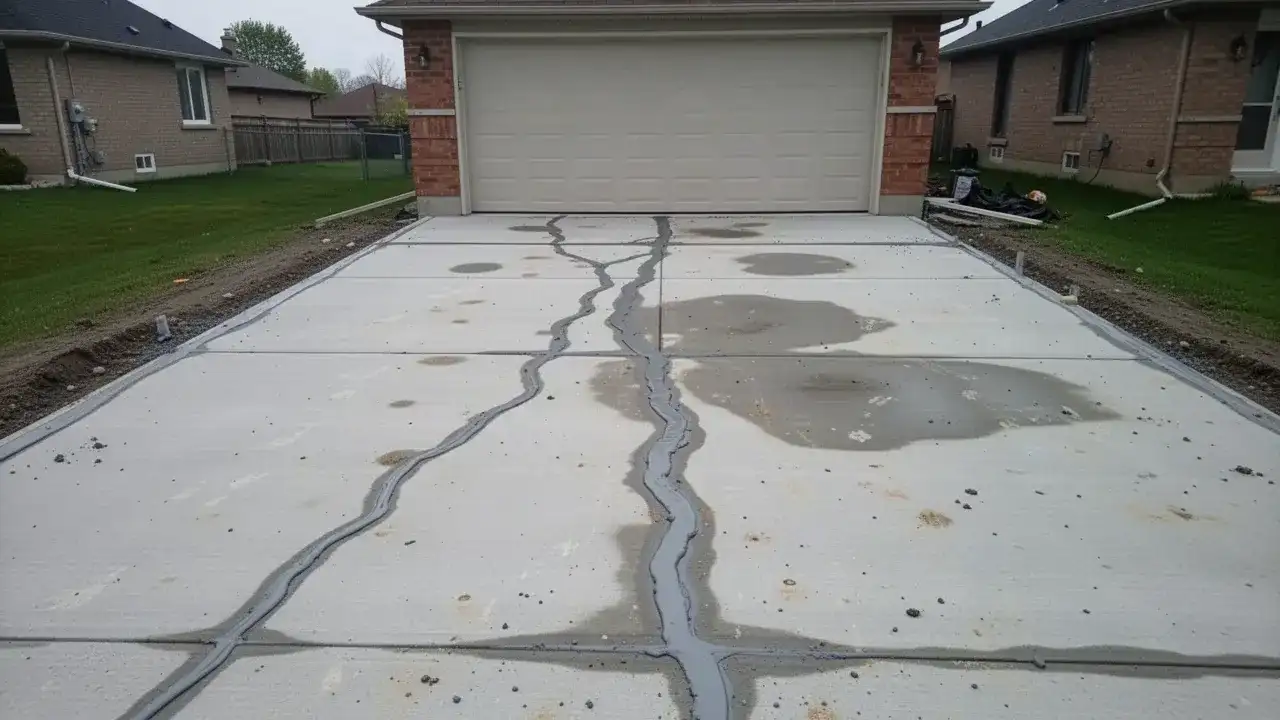
Concrete repair and restoration
Concrete Repair and Resurfacing in London, Ontario
Cracked driveways, flaking front steps and damp foundation walls are the problems Concrete Surface Solutions is called to fix most often in London. We are a licensed, insured and WSIB-covered concrete contractor with 20+ years in the trade and 950+ completed jobs, and that background pouring new slabs is what lets us see why an old one failed.
Homeowners hire us for crack routing, salt-damage patching, resurfacing overlays, parging and foundation crack injection. Property managers and business owners use the same crews for spalled loading docks, plaza sidewalks and curbs that years of winter salting have eaten into.
Before we quote, you get a straight answer on whether a repair will hold or whether replacing the section is the smarter spend.
- 20+ years experience
- 950+ jobs completed
- Licensed & insured
- WSIB covered
What we fix
Concrete Repair Services for London Homes and Businesses
We repair concrete at houses, townhouse complexes, plazas and light-industrial buildings across London, from one cracked step to a full line of parking-lot curb. Nearly all of the damage traces back to freeze-thaw cycling, road salt or a soft base under the slab.
Each method below suits a different kind of failure, so matching the method to the cause is the first decision we make on site. If a slab has simply dropped, our concrete leveling and slab lifting service is often cheaper than any surface repair.
Crack Repair and Routing
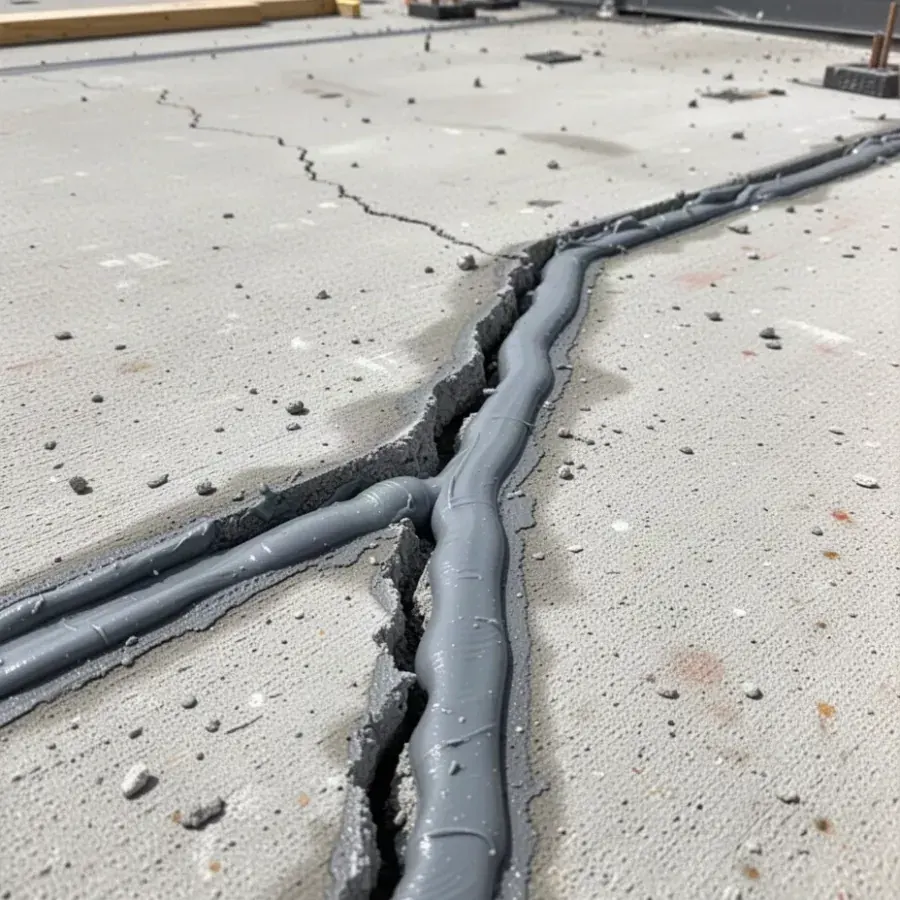
Slab cracks are sealed by routing, not by smearing filler over the top. We cut a clean reservoir about 6 to 10 mm (1/4 to 3/8 in.) wide with a crack-chasing blade, blow it out, add backer rod on deep cracks and fill it with flexible polyurethane sealant.
Rigid epoxy is kept for dormant cracks in structural members. On a slab on grade it simply cracks again beside the repair.
Scaling, Spalling and Salt-Damage Repair
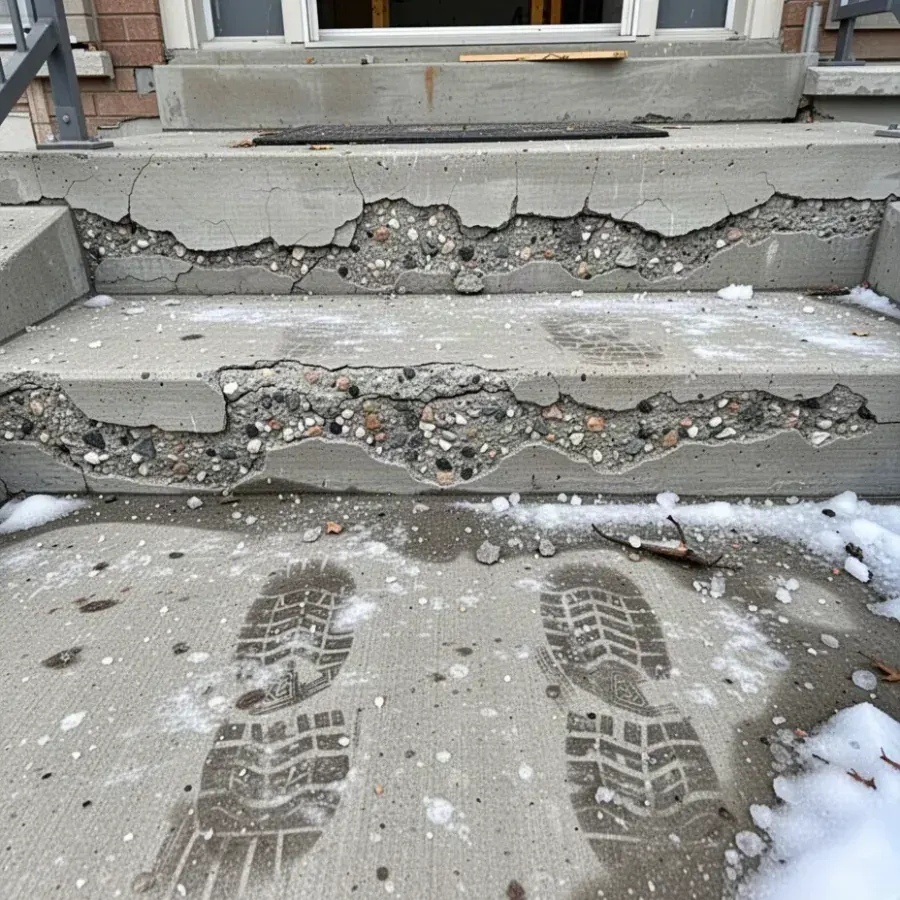
Scaling is shallow flaking of the top few millimetres; spalling is deeper chunks breaking away, often over rusting steel or a delaminated layer. We chip or grind back to sound concrete, saw-cut the patch edges square to avoid thin feather edges, and rebuild with a polymer-modified repair mortar rated for freeze-thaw exposure.
Crumbled step nosings are formed and rebuilt to their original profile.
Resurfacing and Polymer Overlays
A polymer-modified cementitious overlay, placed 3 to 10 mm thick, gives a worn but sound slab a brand-new wearing surface. We grind or pressure-wash to open the pores, prime, spread the overlay, finish it with a broom or knockdown texture and re-cut the original control joints.
Overlays only work over concrete that is structurally sound and no longer moving.
Parging and Foundation Wall Coatings
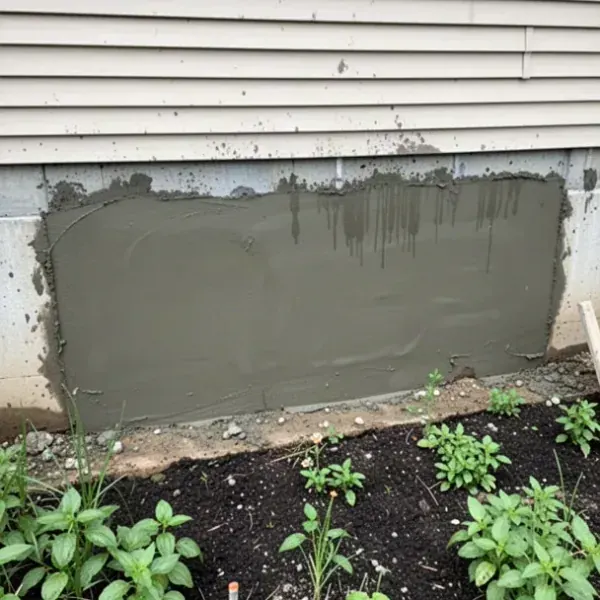
Parging is a cement-based coat, usually 6 to 12 mm thick, that protects and finishes the exposed part of a foundation wall above grade. We strip loose old parge, wire-brush and dampen the wall, apply a bonding agent, then build a scratch coat and a finish coat that is kept moist while it cures.
Parging guards block and poured walls against weather and looks clean, but it is not waterproofing for the buried portion of the wall.
Foundation Crack Injection
A leaking crack in a poured foundation wall is normally sealed from inside the basement by low-pressure injection. We fix ports along the crack, cap the surface with epoxy paste and pump resin in from the lowest port upward until it fills the full wall thickness.
Expanding polyurethane goes into wet or actively leaking cracks, while structural epoxy bonds dry cracks back together. Horizontal cracks, bowing walls and stair-step cracks in block are structural warning signs, so we refer those to an engineer and our concrete foundations and footings team instead of injecting them.
Diagnosis
What's Causing the Damage?
The damage you can see is a symptom, and a repair that ignores the cause usually fails by the next spring. Most concrete problems in London come from a handful of causes, and each one leaves a recognizable pattern.
| Cause | What you see | How we fix it |
|---|---|---|
| Freeze-thaw cycling | Surface flaking, fine map cracking and crumbling step edges, worst on concrete poured without air entrainment | Grind and resurface if shallow; if deep, replace with air-entrained C-2 concrete |
| De-icing salts | Scaling in the tire paths and by the garage door, pitting on steps, rust staining | Patch with freeze-thaw rated mortar, then apply a penetrating sealer |
| Poor base or compaction | Cracks with one side lower, slabs that rock underfoot, standing water | Lift and stabilize, or saw-cut and repour on compacted Granular A |
| Settlement and washouts | Slabs tilting toward the house, steps pulling away from the wall, trip ledges at joints | Foam leveling or void fill, crack sealing, and redirecting the downspout |
| Shrinkage | Random mid-panel cracks and cracks running from inside corners | Rout and seal; add saw-cut joints where the original spacing was too wide |
| Corroding steel | Spalls with rust-stained mesh or rebar showing | Chip out, clean or replace the steel, then patch |
Salt in a slab's first winter is behind much of the early scaling we see on driveways that are only two or three years old. Concrete Ontario's Residential Flatwork Guide advises against any de-icers on new concrete for that first season.
Once a repair has cured, sealing it slows the next round of damage. Our concrete sealing service handles that step with penetrating sealers made for chloride exposure.
Decision guide
Repair, Resurface or Replace?
Repair when the damage is local, resurface when the whole surface is worn but the slab is sound, and replace when the slab or the base beneath it has failed. These are the thresholds we work to on site.
Repair it
- Cracks narrower than 6 mm (1/4 in.) with no height difference
- Spalls or pop-outs on less than about 10% of the surface
- Slab sits level, drains away from the house and does not rock
- Damage limited to one step, corner or joint
Resurface it
- Shallow scaling, under about 6 mm deep, across much of the surface
- No sections lifted, sunk or broken apart
- Only hairline cracks that are no longer growing
- You want a uniform look without the cost of a tear-out
Replace it
- Cracks wider than 12 mm (1/2 in.) or edges offset more than 12 mm
- More than a third of the surface scaled, spalled or showing coarse stone
- Slab broken into several pieces, or the base has washed out
- Water runs toward the foundation and lifting cannot correct it
Replacing rarely means the whole driveway. We saw-cut along existing joints, remove only the failed panels and pour new sections to match; when a full tear-out makes more sense, our concrete driveway installation crew rebuilds it on a proper base.
Front steps that have crumbled past saving are rebuilt by our concrete steps, walkways and porches team on frost-protected footings.
Our process
How We Diagnose and Repair Concrete
Every repair follows the same six stages, whether it is one crack or a full overlay. Skipping the soundness test or rushing surface prep is the most common reason cheap repairs delaminate within a season.
- Inspect and measure
We map each crack, measure widths and offsets, check slope with a level and look at the downspouts, grading and trees around the slab.
- Test soundness
Tapping with a hammer or dragging a chain finds hollow, delaminated areas that no patch can bond to. Those areas get cut out, not covered over.
- Prepare the surface
Patch edges are saw-cut, the area is ground or chipped back to sound concrete, and everything is pressure-washed so the repair bonds to clean, open pores.
- Place the repair
Routed cracks get flexible sealant, spalls get polymer-modified mortar and worn surfaces get a primed overlay, each chosen for exterior freeze-thaw exposure.
- Cure properly
Repairs are kept damp or covered while they gain strength. We avoid working below 5°C or in hot midday sun that dries the surface too fast.
- Seal the work
Exterior repairs get a penetrating sealer once cured, protecting both the new material and the old concrete around it.
A few routed cracks are usually finished in half a day. A two-car driveway overlay typically takes 2 days on site, plus 24 to 48 hours before you drive on it.
Pricing
Concrete Repair Costs in London
Most residential crack repairs in London cost $250 to $600 per crack, and a foundation crack injection runs $550 to $950 per foundation crack. Area work such as resurfacing and parging is priced by the square foot.
| Repair | Typical London price | What moves the price |
|---|---|---|
| Crack routing and sealing | $250 to $600 per crack | Length, width and depth; flat slab or vertical face |
| Foundation crack injection | $550 to $950 per foundation crack | Crack length, wall thickness, access through finished basement walls |
| Resurfacing or polymer overlay | $6 to $10 per sq ft | Grinding and patching needed first, finish texture, joint layout |
| Parging | $9 to $15 per sq ft | Removing old parge, exposed wall height, number of coats |
| Saw-cut and replace a section | $2 to $4 per sq ft to remove, plus $12 to $16 per sq ft for new concrete | Panel size, truck access, finish to match |
Typical 2026 ranges for London and nearby towns, including materials and labour, before HST. Your written quote is fixed after we see the site.
Very small jobs carry a minimum visit charge, which we state on the quote before booking. Bundling work into one visit, such as sealing driveway cracks and parging the foundation on the same day, brings the cost per item down.
Why us
Why London Property Owners Call Us for Repairs
Because we also build new concrete, we can tell you honestly when a repair is worth doing and when it is not. Sometimes that advice means a smaller invoice for us, and we are fine with that.
Written repair warranty
Repairs carry a written 1-year workmanship warranty. Our concrete warranty terms spell out exactly what is covered and what is excluded, in writing, before you sign.
Licensed, insured and WSIB-covered
A certificate of insurance is available on request. Ask for our WSIB clearance certificate too, and confirm it yourself through the WSIB clearance lookup.
Materials made for Ontario winters
We use repair mortars and sealants rated for freeze-thaw and chloride exposure. Replacement sections are poured to CSA A23.1 Class C-2: 32 MPa, 5 to 8% air entrainment, maximum 0.45 water-to-cementing-materials ratio, per CSA A23.1.
Itemized, prioritized quotes
Each crack, patch and square footage is listed separately. You can fix the urgent items now and schedule the rest for next season.
Service area
Concrete Repair Across London and Nearby Towns
We repair concrete throughout London, from Byron and Westmount to Old North and Hyde Park, and in the towns around the city. In St. Thomas, older brick homes often still have original front steps and parged block foundations that are worth patching rather than replacing. Commercial lots in Ingersoll near Highway 401 take heavy salting that eats into curbs and sidewalks.
Homeowners can see everything else we do under residential concrete services, and property managers will find curb, sidewalk and slab work under commercial concrete.
FAQ
Concrete Repair FAQs
These are the questions London homeowners ask most before booking a repair. If yours is not here, include it with your quote request and we will answer it on site.
Can scaled or flaking concrete be resurfaced?
Yes, as long as the scaling is shallow and the slab underneath is sound, level and not cracking through. A polymer overlay bonds to the existing concrete, so it cannot hold together a slab that is heaving, sinking or hollow underneath.
We sound the slab before quoting. If deep scaling or exposed stone covers more than about a third of the surface, replacing those panels is usually the better value, and we will say so.
Will a concrete repair match the existing colour?
Not perfectly, and any contractor promising an invisible patch is guessing. Fresh repair mortar starts out a different shade from weathered concrete, and the contrast softens over one or two seasons as the patch ages.
When appearance matters, a full-surface overlay or a tinted sealer gives one even colour across the whole slab. We talk through those options before any work starts.
How long does a resurfaced driveway last?
A well-prepared polymer overlay on a sound driveway typically lasts 8 to 15 years in London conditions. The upper end depends on resealing every 1 to 2 years and keeping harsh de-icers off the surface.
Overlays fail early when they go over moving cracks or a surface that was never ground open. That is why we will not resurface a slab that fails our soundness test.
Free estimate
Book a Repair Assessment
Tell us what is cracking, flaking or leaking, and attach a few photos if you can. We reply within one business day and book a site visit at a time that suits you.
You will get a written repair, resurface or replace recommendation with itemized prices, so you can decide with the full picture.
- Call or text (226) 243-3585
- Email info@concretesurfacesolutions.ca (attach photos or drawings here)
- Monday to Saturday: 7:00am - 9:00pm
Sunday: 9:00am - 6:00pm
Directions, office hours and what happens after you reach out are on our free concrete estimate page.
Call (226) 243-3585