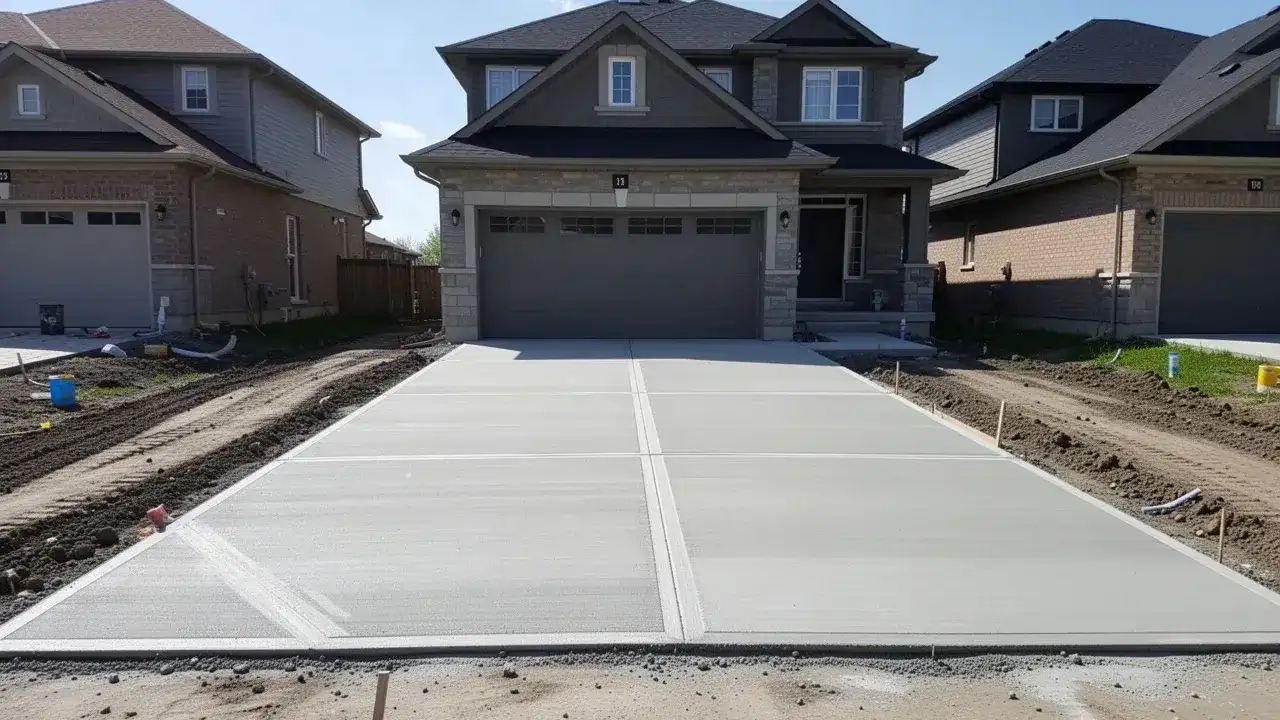
Residential concrete
Concrete Driveway Installation in London, Ontario
A concrete driveway in London has to survive dozens of freeze-thaw cycles, heavy road salt and clay subsoil that heaves when it gets wet. Concrete Surface Solutions builds new, replacement and widened driveways that are engineered for exactly those conditions, from the base up.
Our crews have 20+ years in residential and commercial flatwork and 950+ completed jobs across Middlesex, Elgin and Oxford counties. We work for homeowners replacing a tired slab, families converting from asphalt, and builders who need a driveway poured on schedule for a closing date.
Every quote spells out the mix, slab thickness, base depth and joint layout in writing, so you can compare us line by line with anyone else.
- 20+ years experience
- 950+ jobs completed
- Licensed & insured
- WSIB covered
Driveway services
Our Concrete Driveway Services in London
We install new concrete driveways, replace failed ones, convert asphalt to concrete, widen existing drives and pour aprons and parking pads. Each job starts with the same question: what will this slab carry, and what is the ground underneath it doing?
Homeowners make up most of our driveway work, but we also pour for custom home builders and renovators who want one contractor responsible for grading, base and finish.
New Driveways for Custom and Infill Homes
On new builds we coordinate with the builder and the excavator so the final grade drains away from the foundation before forms go in. Infill lots in older London neighbourhoods often come with tight side yards, so we plan truck access and pumping before pour day.
We also confirm garage slab elevations so the driveway meets the overhead door without a lip.
Driveway Replacement and Asphalt-to-Concrete Conversion
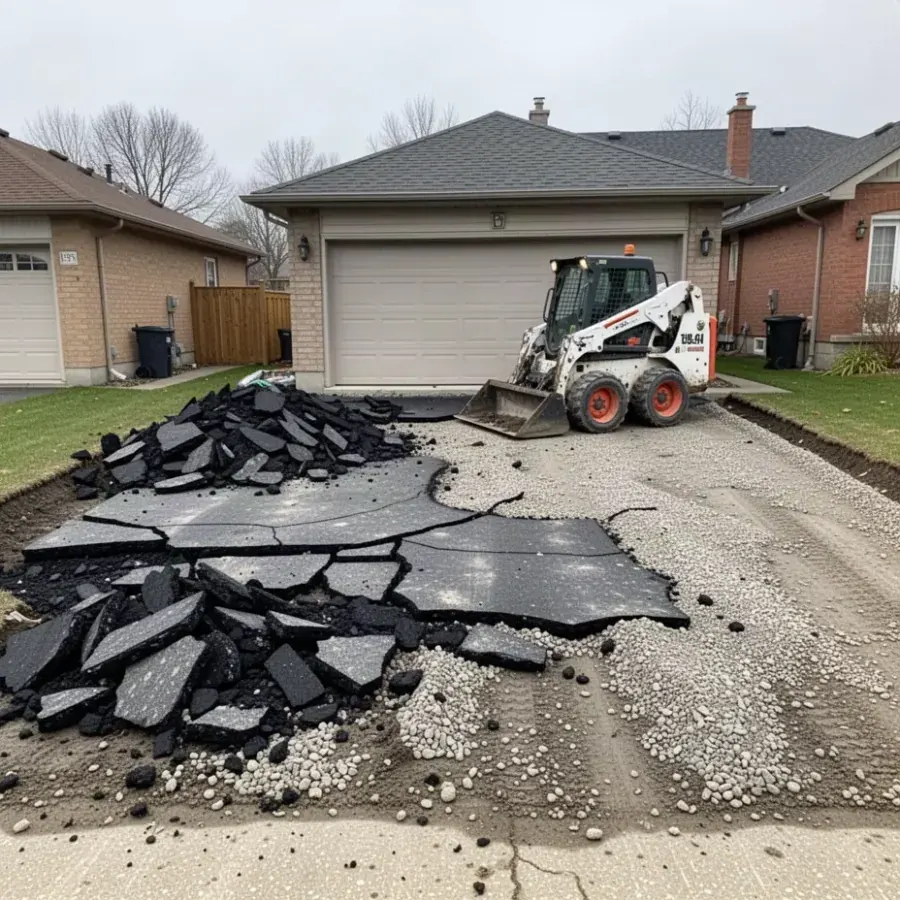
A replacement means full removal, not an overlay on a failing slab. We break out old concrete or asphalt, haul it to recycling, and rebuild the base because a new slab on an old, rutted base inherits the old problems.
Asphalt conversions are one of our most common requests, usually from owners tired of sealcoating and patching every few years.
Driveway Widening and Parking Pads
Widening is where London's bylaws matter most. The City limits a residential driveway to 50% of the lot frontage, to a maximum of 8 m, and any change to the curb needs its own permit.
We measure your frontage first and tell you what is allowed before you pay for a design that cannot be approved.
Repair or replace
Signs It's Time to Replace, Not Patch
Replace the driveway when the damage is structural: the slab has heaved, sunk in large sections, cracked into offset pieces, or scaled across most of its surface. Patching those problems only hides a failed base or a mix that was never built for salt.
- Heaving or tilted sections that trip the snowblower, usually from frost acting on wet clay under a thin or missing base.
- Large sunken areas along the garage or sidewalk where fill has washed out or settled.
- Wide or offset cracks wider than about 6 mm, or where one side sits higher than the other.
- Widespread scaling and spalling where the top layer flakes off over much of the surface, a sign of a non-air-entrained mix or early salt.
- Standing water against the house or garage because the slab slopes the wrong way.
Not every bad-looking driveway needs to go. Isolated hairline cracks and light surface wear respond well to our concrete repair and resurfacing work, and a single sunken slab can often be lifted back into place with concrete leveling and slab lifting for a fraction of the cost.
Finishes
Driveway Finish Options
The finish decides how a driveway looks, how it grips under snow and how much upkeep it asks for. All four options below go on the same structural slab, so the choice is about appearance, traction and budget rather than strength.
Many London homeowners combine two: a practical broom field with a decorative border, for example.
Broom Finish: The Practical Default
A broom finish drags a fine-bristle broom across the fresh surface to leave shallow ridges. It gives the best winter traction of any plain finish, costs the least, and needs nothing more than a routine sealer.
It suits anyone who wants a long-lasting driveway without paying for decoration.
Stamped Concrete Driveways
Stamping presses stone, slate or brick patterns into the slab for a high-end look at the curb. On a driveway the trade-off is upkeep, because plow blades, tires and salt wear the sealer faster than on a patio.
Our stamped concrete installation page covers patterns, colour systems and resealing in detail.
Exposed Aggregate Driveways
Exposed aggregate reveals the natural stone inside the concrete, giving a pebbled texture that grips well and hides tire marks and oil spots. It sits between broom and stamped on price and upkeep.
See our exposed aggregate concrete service for stone blends and how the wash-off is timed.
Coloured Concrete and Accent Borders
Integral colour is mixed through the whole load at the plant, so chips and wear never reveal grey concrete underneath. A colour hardener is broadcast onto the surface instead, which gives richer tones and a harder top layer but only colours the top few millimetres.
A stamped brick or exposed aggregate border around a broom field adds curb appeal for $2 to $5 per sq ft extra.
Material choice
Concrete vs Asphalt vs Interlock for a London Driveway
Concrete costs more than asphalt upfront but usually outlasts it by a decade or more, needs less frequent maintenance, and stays cooler and cleaner in summer. Interlock looks premium, yet in London's clay soils it needs regular re-levelling and joint sand to keep weeds and ants out.
| Factor | Concrete | Asphalt | Interlocking pavers |
|---|---|---|---|
| Upfront cost | Mid to high ($12 to $16 per sq ft broom) | Lowest | Highest |
| Typical lifespan | 25 to 30+ years | 15 to 20 years | 25+ years with re-levelling |
| Routine upkeep | Seal every 1 to 2 years | Sealcoat every 2 to 3 years, patch ruts | Re-sand joints, lift and reset sunken pavers |
| Summer heat | Stays cooler, no softening | Gets hot, can rut under jacks and kickstands | Moderate |
| Freeze-thaw and salt | Excellent when air-entrained and sealed | Good, but cracks let water into the base | Good, but individual pavers can heave |
| Weeds and ants | Only at control joints, rarely | Rare | Common in the sand joints |
| Design options | Broom, stamped, exposed, coloured, borders | Black only | Wide range of shapes and colours |
Lifespans are typical ranges for Southwestern Ontario with normal maintenance. Asphalt and paver costs vary by installer, so ask any contractor for a written per-square-foot price.
Our specification
How We Build a Driveway to Survive London Winters
We build to the CSA A23.1 exposure class for salt-exposed exterior flatwork and the 32 MPa minimum the 2024 Ontario Building Code sets for exterior concrete. The spec is written into your quote, not just promised on the phone.
- Mix: CSA A23.1 Class C-2: 32 MPa, 5 to 8% air entrainment, maximum 0.45 water-to-cementing-materials ratio. The microscopic air bubbles give freezing water room to expand, which is what stops scaling.
- Thickness: 100 mm (4 in.) for cars, 125 to 150 mm (5 to 6 in.) for heavy trucks, trailers and RVs.
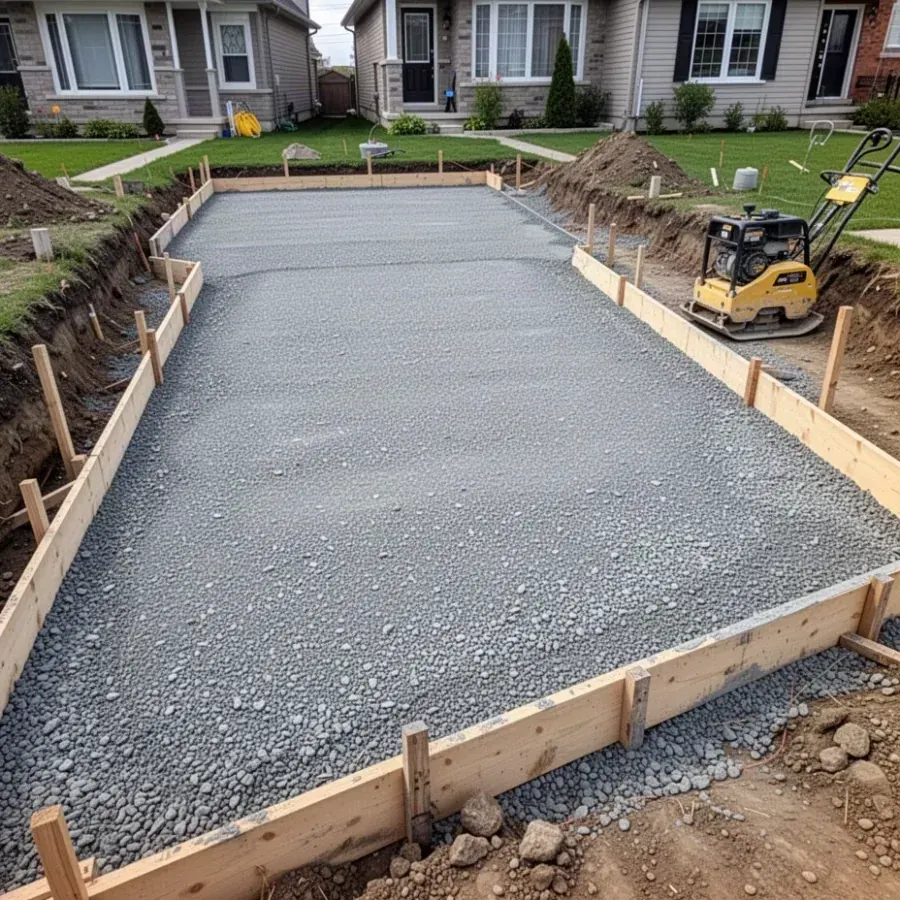
- Base: 150 to 200 mm (6 to 8 in.) of compacted Granular A, placed in lifts over a proof-rolled subgrade so clay soft spots show up before the pour.
- Reinforcement: 10M rebar on a grid for heavy-load and widened sections, welded wire mesh on chairs where requested, or micro-synthetic fibres such as Sika Fibermesh-300 to control early shrinkage cracking.
- Slope: about 1 to 2% away from the garage and house, so meltwater never sits against the foundation.
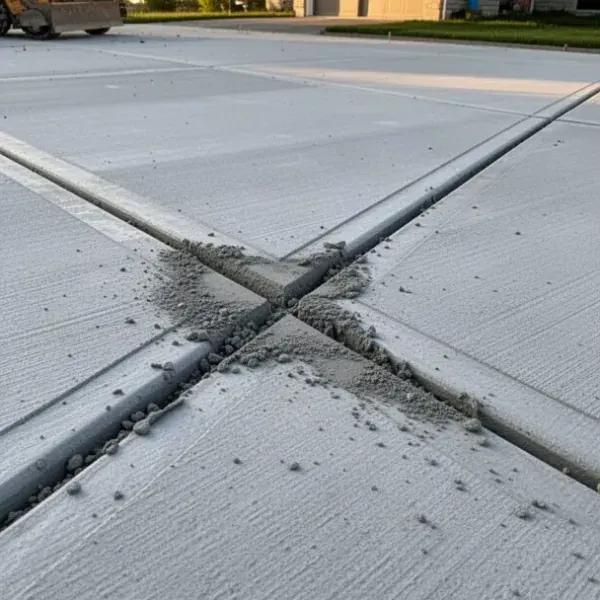
- Joints: saw cut to one quarter of the slab depth, spaced about 8 to 12 ft apart on a 4 in. slab, so cracks form in a straight line where we choose.
Ready-mix comes from certified London plants such as CBM or Amrize London Ready Mix, and we check the delivery ticket against the ordered mix before the chute swings.
Step by step
Our Driveway Installation Process
A typical single or double driveway replacement takes 3 to 5 working days on site, followed by a week of curing before you park on it. Weather can shift a pour date, but we never pour on a frozen base or ahead of an overnight frost without protection.
Here is what happens, in order, once you approve the quote.
-
Measure, Quote and Check City Rules
We measure the driveway, check drainage and confirm the width against the City's driveway rules for homeowners: no more than 50% of the frontage, up to 8 m. If the curb cut changes, we apply for a Work Approval Permit at least 7 days ahead and post the required securities.
-
Removal, Excavation and Base Compaction
After free Ontario One Call locates, we remove the old surface, excavate to depth and inspect the subgrade. Soft clay is dug out and replaced, then Granular A goes down in compacted lifts.
-
Forming, Reinforcing and Pouring
Forms are set to string lines for exact slope, reinforcement is placed, and the concrete is placed, screeded and bull-floated. Edges are tooled and the chosen finish is applied while the surface is at the right stage.
-
Joint Cutting, Curing and Your First Drive
Control joints are saw cut within the first day, then a curing compound holds moisture in. Walk on it after 24 to 48 hours, drive a car after 7 days, and keep heavy trucks off for 28.
Timing the saw cut is where inexperienced crews go wrong. Cut too early and the blade ravels the edges; cut too late and the slab has already cracked on its own, usually diagonally across the middle.
We cut as soon as the surface can take the blade without tearing, typically within 6 to 18 hours depending on temperature. That keeps cracking inside the joints, where it stays invisible.
Pricing
Concrete Driveway Cost in London, Ontario
Most concrete driveways in London cost $12 to $16 per sq ft for a broom finish, with decorative finishes costing more. A typical double driveway of 500 to 700 sq ft lands somewhere in the high four to low five figures once removal is included.
| Item | Typical London range | What drives the price |
|---|---|---|
| Broom finish driveway | $12 to $16 per sq ft | Size, thickness, base depth, access |
| Exposed aggregate driveway | $16 to $21 per sq ft | Stone blend, exposure depth, borders |
| Stamped driveway | $18 to $26 per sq ft | Pattern, number of colours, sealer system |
| Colour or decorative border | $2 to $5 per sq ft extra | Border width and finish type |
| Removal of old concrete or asphalt | $2 to $4 per sq ft | Thickness, rebar, disposal distance |
| Driveway widening | $1,800 to $4,500 for a typical side extension | Length, curb cut, permit and securities |
| Concrete pump | $450 to $900 per pour when a pump is needed | Backyard or tight-access pours |
Typical 2026 ranges for the London area. Your written quote prices the exact scope we measured.
The biggest swing factors are what has to come out, how much new base the soil needs, and whether a truck can reach the forms directly. Stamped and exposed finishes also add labour on pour day and a dedicated finishing crew.
Why us
Why Homeowners Choose Us for Their Driveway
Homeowners choose us because they can see exactly what they are paying for and check our credentials before work starts. Here is what that looks like in practice.
The spec in writing
Mix strength, air content, thickness, base depth and joint spacing all appear on the quote. Few London contractors publish any of these numbers.
A 3-year written warranty
New residential driveways carry a 3-year workmanship warranty with clear coverage and exclusions. Read the terms on our concrete warranty page before you sign.
Insurance and WSIB you can verify
We are licensed and insured, with a certificate of insurance available on request. Ask for our WSIB clearance certificate and confirm it yourself through the WSIB clearance lookup.
950+ jobs of local experience
We have poured across London's clay, sand and fill soils for 20+ years. Browse finished work on our concrete project gallery or read customer reviews on our Google Business Profile.
Planning more than a driveway? We often pour the front walk and steps at the same time through our concrete steps and walkways service, and the full range is on our residential concrete services page.
Service area
Driveway Installation Across London and Nearby Towns
We pour driveways in every London neighbourhood, from older streets in Old South and Westmount to newer subdivisions in Hyde Park and Lambeth. Outside the city, permit rules change with the municipality: in Strathroy, driveway entrance and curb approvals go through the Municipality of Strathroy-Caradoc, or Middlesex County on county roads, rather than London City Hall.
In Ingersoll, about about 25 minutes from our Consortium Court yard, owners who park work trucks or trailers at home often need the thicker 125 to 150 mm slab.
FAQ
Concrete Driveway Questions
These are the questions London homeowners ask most often before booking a driveway. If yours is not here, call us at (226) 243-3585.
How long does a concrete driveway last in Ontario?
A properly built concrete driveway in Southwestern Ontario typically lasts 25 to 30 years, and many go longer. That figure assumes an air-entrained C-2 mix, a compacted granular base, joints cut on time and a sealer renewed every 1 to 2 years.
Driveways fail early when the first winter brings heavy salt, when water pools along the garage, or when the base was skimped. Our concrete sealing service is the cheapest way to protect the surface once the slab is down.
How thick should a concrete driveway be?
We pour 100 mm (4 in.) for cars, 125 to 150 mm (5 to 6 in.) for heavy trucks, trailers and RVs. The extra depth matters where a driveway carries a work truck, a boat trailer or an RV parked for months at a time.
Thickness only works on a solid foundation, so every driveway also gets 150 to 200 mm (6 to 8 in.) of compacted Granular A underneath it.
Should I seal a new concrete driveway, and when?
Yes. Concrete Ontario recommends sealing exterior flatwork and resealing every 1 to 2 years in salt country. We either apply a cure-and-seal product on pour day or wait about 28 days for the slab to cure before applying a penetrating sealer such as Sikagard-219.
After that, a fresh coat each year or two keeps chlorides and water out of the surface paste.
Can I use salt on my driveway the first winter?
No. The Concrete Ontario residential flatwork guide advises against any de-icing chemicals during the first winter, while the surface is still gaining strength. Use clean sand for traction instead.
After year one, plain rock salt in moderation is fine on sealed, air-entrained concrete. Avoid de-icers that contain ammonium nitrate or ammonium sulphate at any age, and rinse off the salty slush that drips from vehicles.
Free estimate
Get Your Free Driveway Quote
Tell us the approximate size, what is there now and the finish you are leaning toward. We will reply within one business day to book a measure or quote from photos.
Every quote includes the written spec, the warranty term and any permit work needed for widening.
- Call or text (226) 243-3585
- Email info@concretesurfacesolutions.ca (attach photos or drawings here)
- Monday to Saturday: 7:00am - 9:00pm
Sunday: 9:00am - 6:00pm
Directions, office hours and what happens after you reach out are on our free concrete estimate page.
Call (226) 243-3585